by Charles Reynolds
Charles Reynolds has recently acquired British hillclimb champion David Boshier-Jones’ Cooper JAP. He went to have lunch with him in South Wales and has written this two-part account of his Cooper career. David is a spry 93-year-old who retains clear memories and has kept precise records of his career and rise to fame as Cooper-twin mounted British Hillclimb Champion in 1958, 1959 and 1960. First is Charles’ account of David’s early 500cc racing days and this will be followed by an account of his winning the RAC British Hillclimb Championships of 1958, 1959 and 1960.
The Boshier-Jones family ran the Newport Garage in the town of that name in South Wales which had held an Austin agency since 1922. David Boshier-Jones’ grandfather had competed in many local hillclimbs in a Gwynne Eight, so sparking the interest in motorsport of David and his younger brother Peter. At the tender age of 20, David managed to convince his father to buy a Kieft 500, then made in nearby Bridgend, and he started racing it in 1952.
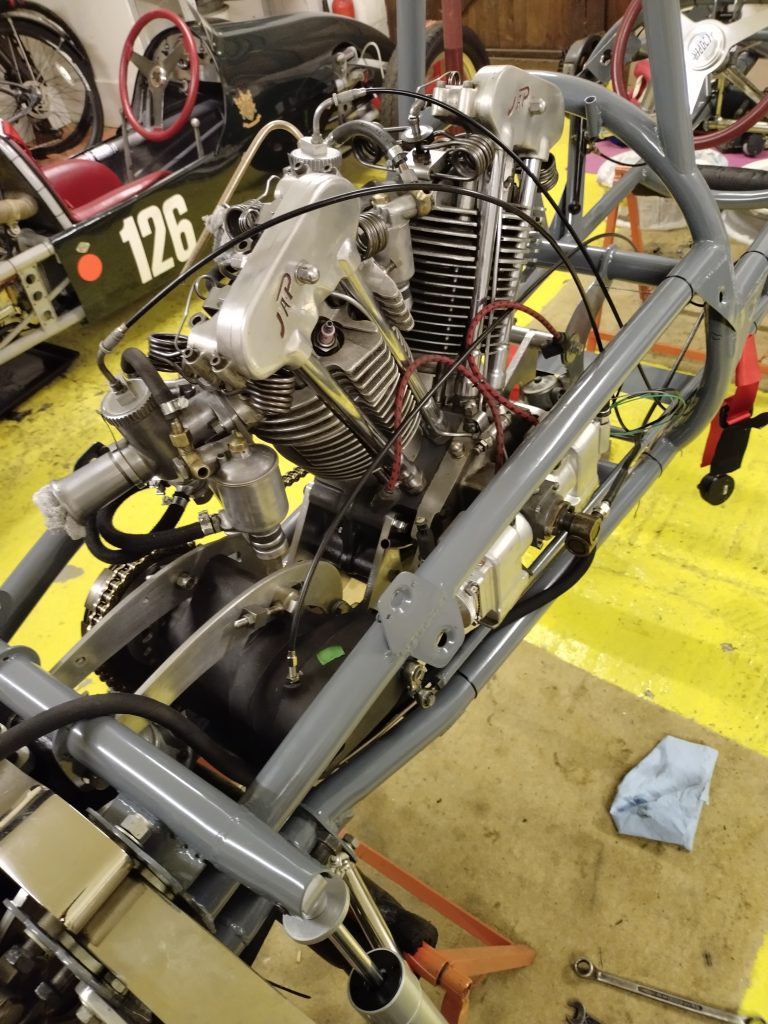
The Boshier-Jones Cooper with a fabulous British racing and hillclimb history is now owned by author Charle Reynolds
David had been impressed by the prototype Kieft driven by Stirling Moss which had won eight races in late ’51 and early ’52 and it seemed sensible to buy a Kieft, even though it would be JAP-powered at a time when the top drivers were buying complete Norton motorcycles to acquire Manx engines. In reality the production Kieft proved to be quite heavy and unreliable and in David’s opinion Cyril Kieft should not have been in the racing car business and should have stuck to making kitchen pots and pans at his Wolverhampton factory.
David’s first event was on 20 April (Easter Sunday) 1952, at a hill-climb at Lydstep Haven near Tenby in Pembrokeshire. It was 880yds long from the beach using a holiday camp road. David finished in a class second behind Jack Moor’s Wasp and was 3rd overall. In that first year he contested 13 events with 6 podium placings which was a good start considering the reliability of 500’s in that era. He was fortunate in have an excellent mechanic from the garage, a committed bachelor who stayed with him until 1960. He and David learnt a lot about the sport and chalked up many hundreds of travelling miles in the pre-motorway era well before the Severn bridge was built and made travel from South Wales a lot more convenient.
Through the 1953 and 1954 seasons the Boshier-Jones team persisted with the Kieft which was eventually fitted with a Manx Norton engine. They engaged Don Parker at one stage to try and cure the car’s unreliability. The car was tricky to drive with its pronounced front seating position and swing axle rear suspension; one small error meant the car was difficult to hold, especially in the wet. The original design had been ahead of the opposition, but others had now caught up and had gravitated to a conventional mid-seat spaceframe chassis with wishbone suspension. David decided to buy a new Mk9 Cooper which had just been introduced for 1955.
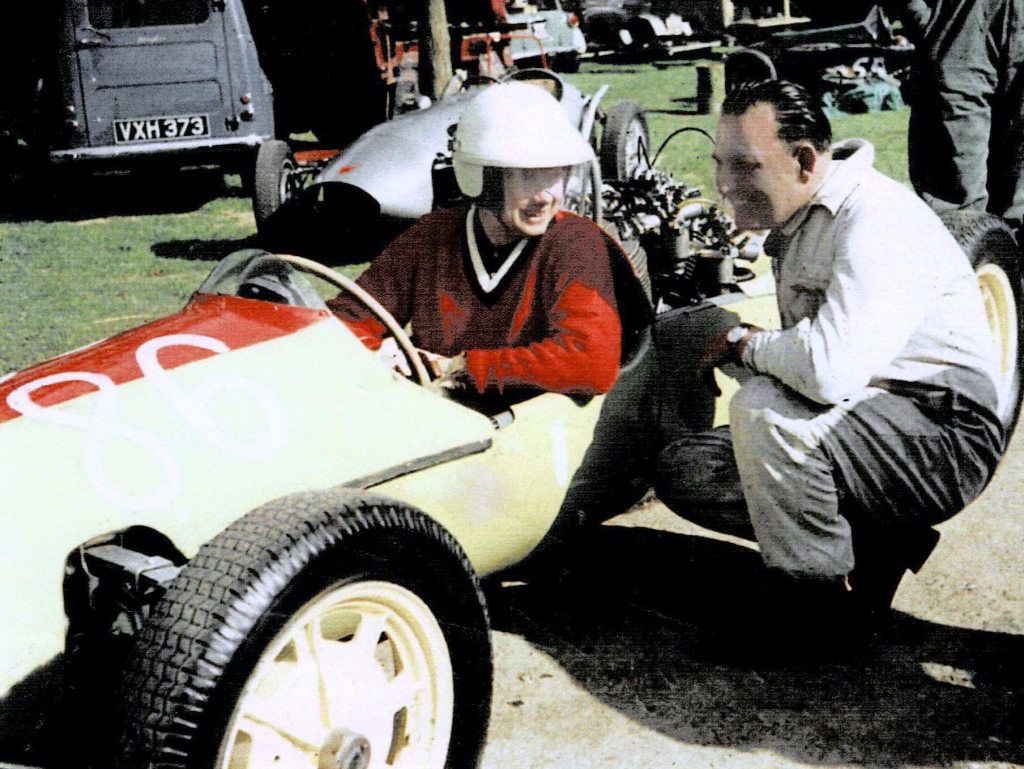
David Boshier-Jones with his long-time mechanic Les Ryland.
The Norton unit from the Kieft was fitted to the Cooper after Robin Jackson had upgraded it, including one of his twin-plug heads as earlier featured in Loose Fillings. The Cooper was much more forgiving than the Kieft although it took some time to get used to – David says he really needed miles behind the wheel and unfortunately there was nowhere to test the car locally so his learning curve tended to be at races or on the hills.
David’s first Cooper race was on Easter Monday at Goodwood where unfortunately he retired due to a fuel blockage. Then in May he was 10th at Silverstone followed by 6th in his class at Prescott two weeks later. In mid-June he was at Brands Hatch where he was 4th in his heat and 7th in the final. Also in June there was a big meeting at Shelsley Walsh, again run in the rain, where he was 2nd to Don Parker’s Kieft. A week later at Brands Hatch he won both his heat and the final before going to Prescott the next day on his way home where he won the 500class ahead of Henry Taylor and Austen May. At last, he says, things were looking up!
This first year with the Cooper was really busy and tiring yet rewarding. David and his team contested an extraordinary 26 events, had won 20 awards and he had finished 4th overall in the national 500 championship behind Jim Russell, Ivor Bueb and Stuart Lewis-Evans. But where to next? The 500 movement had peaked and interest was starting to decline as the sport became more professional; Coventry Climax was producing competitive 1100cc engines and sportscar racing had gained a foothold. Nonetheless 500 races were invariably closely fought and exciting.
Now 25 and married with a second child due, David didn’t want to follow others chasing the few Formula 1 seats. But at the 1955 Motor Show in London he met with Colin Chapman and Reg Tanner from Esso. Chapman agreed to loan him a car while Esso would supply a Coventry Climax engine. Reflecting on the increasing number of accidents at the top level and his responsibility to his family, David decided to do another year in F3. So in 1956, with a family to support and increasing work pressure, he felt it was time to cut back a bit on his motorsport activities and he only contested 10 events that year, gaining five awards.
At the end of September came David’s major success of the year, with this time winning the Commander Yorke Trophy from Tommy Bridger and Ivor Bueb. In the 100-mile final both the car and David were on good form and he led throughout. He was well clear of Jim Russell whose turn it was to break a drive-shaft. This was a satisfactory conclusion to a year of fewer events and one during which David also made the decision to concentrate on hill-climbing in future. He had always enjoyed the individual and precise nature of the discipline where no one else was going to take you off.
His idea was simply to install a JAP V-twin in his Mk9 Cooper; however John Cooper advised that the car would be better balanced and more serviceable by extending the chassis by 2” (factory twins are thought to have been 3″ longer – Ed) so the Cooper went back to Surbiton for the work to be done. At the same time he bought a new V-twin engine direct from the JAP factory in Tottenham which was installed at Cooper’s works and which Robin Jackson agreed to look after.

His absolute commitment and concentration can be seen as David Boshier-Jones rounds the last hairpin at Scotland’s Rest and be Thankfull hillclimb in his big-twin Cooper.
Whilst this was going on, Robin Jackson asked David if he would drive his 500cc Cooper in selected races. Robin would look after the car and David would drive it, although there was nothing financially in it for him. David would never know why Robin wanted to run his own car … perhaps it was to parallel the Moss/Beart relationship which later extended to Les Leston, Colin Davis and Stuart Lewis Evans.
One problem of the relationship was that Robin expected David to be available for testing and other work at any time, which proved tricky as he had a full-time job at the garage. There were few professional drivers back then, and David says he wasn’t one of them! (may delete this last para). David’s Boshier-Jones’ first outing in 1957 with the JAP V-twin was at Prescott where he was third in the Formula Libre class behind Michael Christie and Tony Marsh, also on Cooper V-twins. At the end of June David went all the way to Scotland for the next round of the RAC Championship at Rest-and-be-Thankful. This was a totally new hill for him so he took it easy, again coming third to Tony Marsh and Michael Christie.
To be continued
This story has been drawn from the 500 Owners’ Association Yearbook which was published in early 2025.
 RECENT POSTS